Decanter Centrifuge for Red Mud Slurry Dewatering
Description
The Decanter Centrifuge for Red Mud Slurry Dewatering is designed for continuous solid-liquid separation, red mud thickening, alkaline liquor recovery, and process-water clarification in alumina refining and bauxite-residue treatment systems.
Red mud slurry is typically dense, highly alkaline, abrasive, and variable in solids concentration. It may contain iron oxides, alumina, silica, titanium compounds, residual caustic liquor, sand, and fine mineral particles. The decanter centrifuge continuously separates and thickens the solids while recovering clarified liquor for washing, recycle, recovery, or further treatment.
Thickened red mud can be transferred to a filter press, belt filter, residue washing system, storage pond, dry-stacking section, or further dealkalization process.
Typical Applications
- Bayer-process red mud slurry thickening
- Bauxite residue washing and liquor recovery
- Red mud settling-tank underflow treatment
- Alkaline wastewater solids removal
- Caustic liquor recovery before residue disposal
- Red mud washing-stage slurry separation
- Fine mineral solids recovery
- Filter press feed thickening
- Dry-stack residue pre-dewatering
- Alumina refinery wastewater sludge treatment
Red Mud Slurry Dewatering Solution
Peony provides continuous solid-liquid separation for red mud thickening, wash-liquor recovery, and downstream residue handling.
Red Mud Washing / Settling Tank Underflow → Agitated Slurry Tank → Optional Flocculant Dosing → Decanter Centrifuge → Thickened Red Mud → Filter Press / Belt Filter / Dry Stacking / Storage
Clarified Alkaline Liquor → Wash Water Tank / Liquor Recovery / Further Treatment
Peony can provide:
- Decanter centrifuge selected for red mud solids concentration and abrasiveness
- Agitated slurry buffer tank for stable feeding
- Heavy-duty feed pump and flow regulation system
- Optional flocculant dosing and mixing system
- Adjustable differential speed and pond depth control
- Wear protection for feed zone, scroll flights, bowl cone, and solids outlet
- Alkaline-liquor collection and recycle connection
- PLC and VFD automatic control system
- Connection to filter press, belt filter, storage, washing, or wastewater treatment system
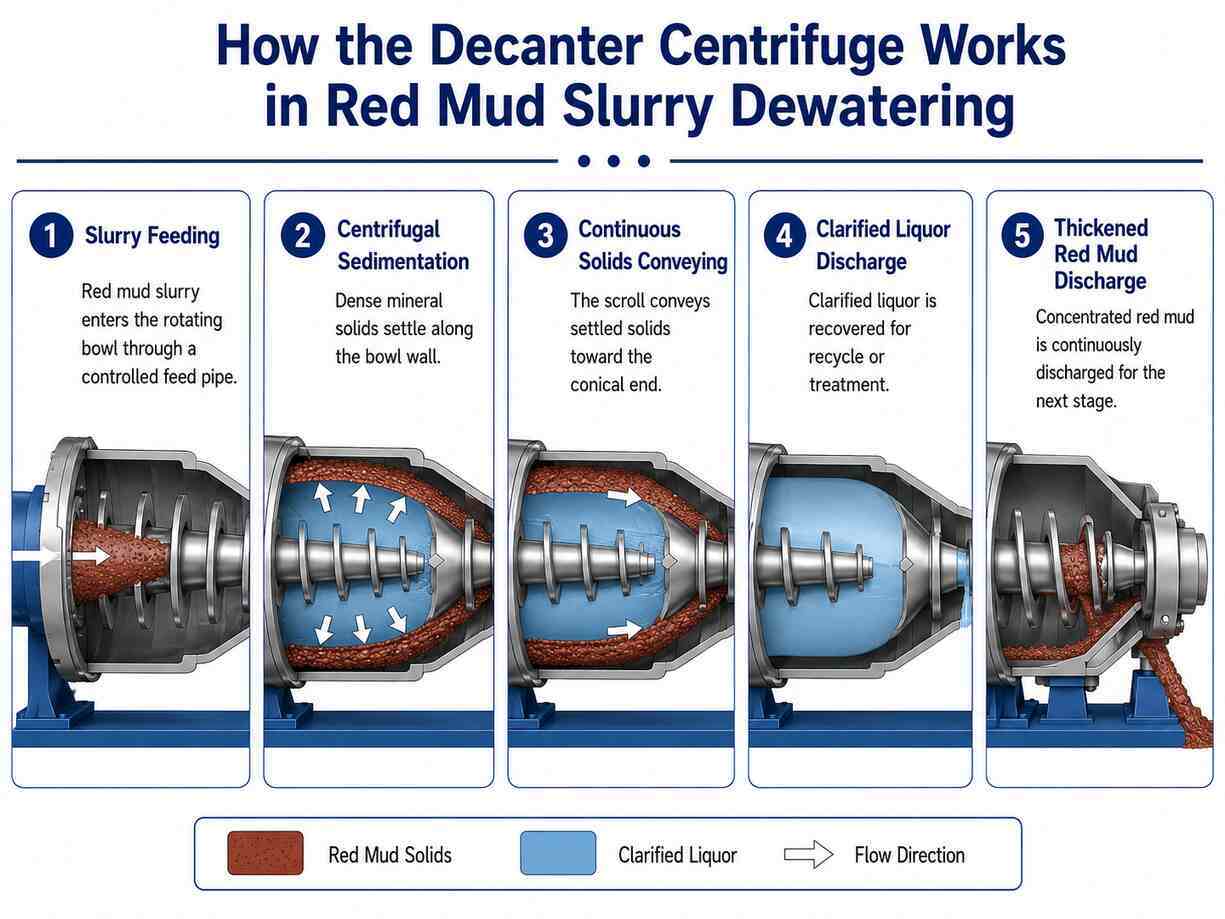
How the Decanter Centrifuge Works
1. Red Mud Slurry Feeding
Red mud slurry enters the rotating bowl through a controlled feed pipe.
An agitated buffer tank is normally recommended upstream to prevent settling, reduce solids fluctuation, and maintain stable feed conditions.
2. Centrifugal Sedimentation
Inside the high-speed bowl, centrifugal force separates red mud solids from the alkaline liquid phase.
The dense mineral particles move outward and form a solids layer against the bowl wall, while clarified liquor remains closer to the center.
3. Continuous Solids Conveying
The internal screw conveyor rotates at a controlled differential speed relative to the bowl.
This movement transports settled red mud solids toward the conical end for continuous discharge.
4. Clarified Liquor Discharge
The separated liquid leaves through the liquid outlet.
Depending on the plant process, it can be returned to residue washing, routed to caustic liquor recovery, transferred to a recycle-water tank, or sent for further treatment.
5. Thickened Red Mud Discharge
The concentrated red mud is discharged continuously from the solids outlet.
It can be transferred to a filter press, belt filter, storage area, dry-stacking section, residue washing stage, or disposal system.
Technical Parameter
| Model |
Diameter (mm) |
Length (mm) |
Length-to-diameter rate |
G force |
Max solid discharge (m³/h) |
Weight (kg) |
Dimension (L*W*H) (mm) |
| PDC-10 |
250 |
1000 |
4 |
4080 |
0.4 |
1000 |
2410*800*1080 |
| PDC-12 |
4200 |
1350 |
4 |
3500 |
0.6 |
1200 |
2610*800*1080 |
| PDC-12 |
4200 |
1350 |
4.5 |
3180 |
1.2 |
1800 |
3495*840*1180 |
| PDC-18 |
4000 |
1600 |
4.5 |
3180 |
1.2 |
3200 |
3497*1020*1385 |
| PDC-18 |
450 |
2150 |
4 |
2500 |
2 |
3800 |
4447*1080*1385 |
| PDC-20 |
400 |
2250 |
4.5 |
2500 |
3.5 |
4000 |
4580*1140*1470 |
| PDC-21 |
530 |
2280 |
4.3 |
2500 |
5 |
5000 |
4924*1170*1540 |
| PDC-26 |
655 |
2800 |
4.3 |
2270 |
8 |
7000 |
4300*1900*1350 |
Key Selection Considerations
High Alkalinity
Red mud slurry often contains residual alkaline liquor. Material selection, seals, piping, pumps, and downstream connections should be evaluated based on actual pH, temperature, chloride content, and chemical composition.
Abrasion Level
Iron-bearing minerals, silica, sand, titanium compounds, and other hard particles can cause accelerated wear. Wear-resistant protection should be selected according to particle size, solids concentration, and expected operating hours.
Slurry Concentration and Viscosity
Red mud can be dense and may show variable settling behavior. Stable feed concentration is important for consistent throughput and solids discharge.
Flocculant Compatibility
Flocculant may improve settling and clarified-liquor quality in some applications. Selection and dosage should be confirmed through slurry testing to avoid excessive chemical consumption or unstable solids discharge.
Final Solids Requirement
A decanter centrifuge is mainly used for continuous thickening and primary dewatering. For lower final moisture or dry-stacking duty, it is commonly combined with a filter press, belt filter, vacuum filter, or other final dewatering equipment.
Liquor Recycle Requirement
Clarified liquid should be evaluated based on suspended solids, residual caustic, conductivity, dissolved salts, and the requirements of the next washing or recovery stage.
Main Advantages
Continuous Red Mud Thickening
The decanter continuously thickens red mud slurry without batch interruption, making it suitable for high-volume refinery residue streams.
Abrasion-Resistant Configuration
Red mud may contain hard mineral particles and sand. Wear protection can be added to the feed chamber, scroll flights, bowl cone, and solids discharge section.
Alkaline Liquor Recovery
Clarified liquid can be collected for wash-water reuse, caustic recovery, or further treatment, reducing liquid loss from the separation stage.
Stable Operation Under Variable Feed Conditions
Bowl speed, differential speed, pond depth, and feed rate can be adjusted to manage changes in solids concentration, viscosity, particle size, and throughput.
Enclosed Automatic Handling
The enclosed centrifuge design reduces slurry splashing, manual handling, and exposure to alkaline process liquid.
What Data Is Needed for Selection?
Please provide the following information for a suitable red mud slurry dewatering solution:
- Red mud source and process stage
- Slurry solids concentration and density
- Particle-size distribution and fine-particle content
- Slurry viscosity and temperature
- pH, caustic concentration, and chloride content
- Required processing capacity
- Target solids concentration after centrifugation
- Required clarified-liquor quality
- Flocculant or polymer currently used
- Abrasive mineral or sand content
- Downstream filter press, belt filter, storage, or dry-stacking arrangement
- Required material of construction
- Electrical and control standard
FAQ
Can a decanter centrifuge dewater red mud continuously?
Yes. A decanter centrifuge is suitable for continuous red mud thickening and primary dewatering, particularly where slurry flow and solids concentration change during operation.
Can the clarified liquor be reused?
In many cases, yes. The clarified liquor may be reused in red mud washing, process-water recycle, or alkaline liquor recovery. Final reuse depends on suspended solids, caustic concentration, conductivity, and process requirements.
Is wear protection necessary for red mud slurry?
Usually yes. Red mud can contain abrasive mineral particles, sand, silica, and iron-rich solids. Wear protection for the scroll, feed zone, bowl cone, and solids outlet is generally recommended.
Can a decanter centrifuge replace a filter press?
The decanter is mainly used for continuous thickening and primary dewatering. When lower final moisture or dry-stack residue is required, a filter press, belt filter, or vacuum filter may still be needed downstream.
Is flocculant dosing required?
Not always. It depends on particle size, settling behavior, solids concentration, clarified-liquor target, and required recovery rate. Slurry testing is recommended before confirming the dosing system.
Contact Peony for Partnership